Gentrification of the Modern City: Open Lecture on Urban Geography
On October 14, 2026, at 12:00, an open lecture on the topic “Gentrification” was held online within the framework of the interfaculty elective course “Geourbanism”. The class was conducted by Kateryna KRAVCHENKO, Doctor of Geographical Sciences, Associate Professor, Professor of the K. Niemets Department of Human Geography and Regional Studies, Dean of the Faculty of Geology, Geography, Recreation and Tourism.
Gentrification is one of the most controversial processes of modern urban development, because the renewal of buildings, improvement of infrastructure and increasing the investment attractiveness of territories can be accompanied by an increase in the cost of living, a change in the social composition of the population and displacement of less well-off residents.
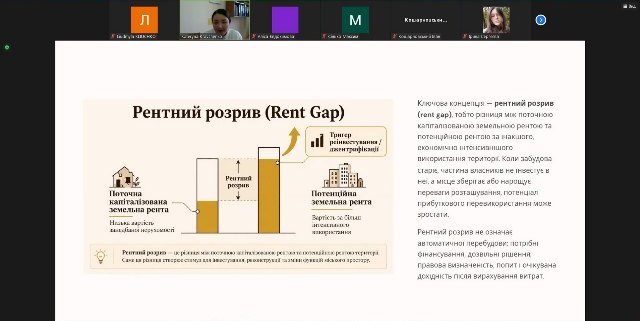
During the lecture, students from various faculties of Karazin University were introduced to the theoretical foundations of gentrification, its economic mechanisms, socio-cultural factors and spatial consequences. Particular attention was paid to Neil Smith’s theory of the rent gap, the concepts of urban authenticity, socio-spatial inequality and the right to the city.
Using the examples of London, New York, Berlin, Barcelona, Sydney and Lisbon, various trajectories of urban transformation were examined – from the revitalization of former industrial spaces to green and tourist gentrification. A separate block of the lesson was devoted to Ukrainian cities, in particular the transformation of Kyiv’s Vozdvizhenka, the prospects for the development of Kharkiv and the potential risks of social inequality in the process of post-war reconstruction.
An important component of the lesson was the use of the interactive platform Slido, with the help of which a survey was organized on the perception of urban space renewal, understanding of the signs of gentrification and the priorities for the restoration of Ukrainian cities. This format allowed to capture students’ views on current issues of urban development.